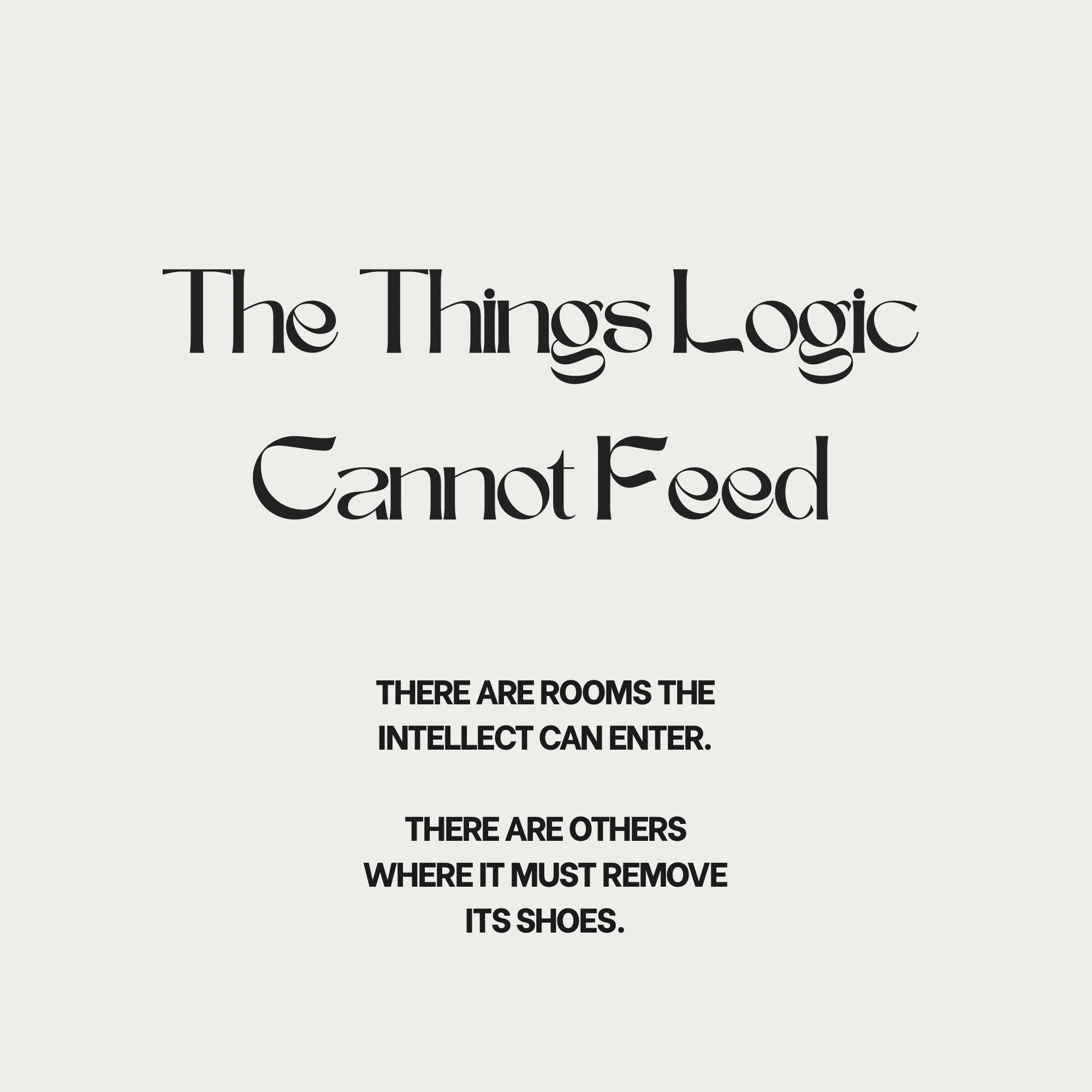
The Things Logic Cannot Feed
There is a peculiar poverty in a life that has learned how to explain everything.
We have become suspicious of mystery.
We want to know why the child died, why the marriage failed, why the heart broke, why the stranger appeared at precisely the right moment. We dissect our suffering until it becomes psychologically intelligible, believing that if we can name a thing, we have somehow conquered it.
But the soul is not a laboratory.
You can explain the chemical composition of a rose and still not know why a rose can make a grown man remember his mother.
You can describe love in neurological terms and still be unable to explain why you would willingly suffer for someone else.
You can map grief through the brain and still find yourself standing at a graveside speaking to someone who cannot answer.
There are forms of knowledge that cannot be obtained by analysis.
A mother knows the sound of her child’s cry.
A man knows the weight of his own conscience.
A lover knows the difference between being desired and being cherished.
And somewhere beneath all of this, the soul knows that it was made for something the visible world cannot quite provide.
This is why a perfectly rational life can still feel unbearably empty.
The intellect can tell you what a thing is.
It cannot always tell you what it is for.
It can measure the stars but cannot tell you why their vastness makes you ache.
It can explain the mechanics of prayer but cannot account for the strange peace that sometimes arrives when you have nothing left to say.
It can tell you that your child will eventually grow up, but it cannot explain why you want to stop time when he falls asleep against your chest.
We were not created merely to understand reality.
We were created to participate in it.
To love it.
To suffer in it.
To wonder at it.
To worship its Creator.
Faith does not require the death of reason.
It requires the humility to admit that reason is not God.
There are rooms the intellect can enter.
There are others where it must remove its shoes.
And perhaps wisdom begins when we stop demanding that every sacred thing become explainable before we allow it to become holy.
B🤍
Leave a Reply